One Shot to Get It Right

5 Financial Decisions You Should Prepare for Years in Advance
Most financial decisions can be revisited.

A portfolio can be rebalanced next quarter, or a budget adjusted next month. But a handful of decisions do not work that way. You may only retire once. Or help parents as they age, or receive an inheritance. Or you may sell a business once or put an estate strategy in place that is designed to hold up long after you are no longer there to explain it.
These moments share something important: by the time they arrive, most of the meaningful choices have already been made. What looks like a single decision is often the final visible step in a process that began years, and sometimes even a decade, earlier.
That gap between when a decision happens and when the preparation for it should have started is the idea running through everything below. Families who navigate these five moments well may not be the ones with the most assets. They are often the ones who started asking questions and organizing their paperwork long before anyone forced their hand. Families who struggle may be the ones who treat a life event as the starting gun rather than the finish line.
Artificial intelligence deserves a mention here, since it now answers financial questions faster than any of us can type them. Some find that AI is genuinely useful for gathering information, explaining how a Roth conversion works, or estimating long-term care costs in your state.* But what about weighing that information against your family’s specific circumstances and values or noticing the thing you didn’t think to ask about? Information is increasingly a commodity. Judgment, applied to your particular life, still is not.
How Early Should You Start Preparing for Retirement?
Most people picture retirement as something that happens gradually over a career and then concludes on a specific date. In practice, the decade before retirement does most of the work, and the decisions made during that window can shape decades of outcomes that follow.
Here's a statistic that may surprises you: 46 percent of retirees in EBRI’s 2026 Retirement Confidence Survey left the workforce earlier than they had anticipated.
When asked why they retired earlier than expected, many retirees cited more than one reason:
41 percent cited a health problem or disability
35 percent cited changes at their employer, such as a layoff or restructuring
36 percent said they left simply because they felt they could afford to
Preparing for retirement “someday” assumes you will get to choose the day. For nearly half of retirees, that timeline was rewritten, sometimes by circumstance and sometimes by choice, but rarely on schedule. The practical takeaway is that flexibility, not just account size, can determine whether an unexpected exit becomes a crisis or simply a minor detour.
Flexibility shows up most clearly in how your money is taxed. Consider how U.S. households actually hold their retirement savings:
Roughly 33 percent own a traditional, tax-deferred IRA
About 28 percent own a Roth account
Only 17 percent own both
A household with most of its retirement savings in tax-deferred accounts will have the entire withdrawal amount taxed as ordinary income. Once required minimum distributions begin, a household may face limited choices. Your tax, legal, or accounting professional can help you better understand how this will apply to your situation.
There is also a lesser-known risk hiding in the years right around retirement: the danger of experiencing poor market returns early in retirement while you're withdrawing money.
Research on what’s called sequence of returns risk—the risk that the order in which investment returns occur can affect how long a portfolio lasts when withdrawals are being made—shows that the financial market return an investor experiences in their very first year of retirement can explain nearly 14 percent of how a 30-year retirement income strategy ultimately performs, more than any other individual year.
Two retirees with identical savings and identical long-term average returns can end up in very different financial positions simply because of which years the markets happened to decline around their retirement date. This is precisely why retirement income is a different discipline than retirement savings. Saving asks how much you’ll have. Income asks how you’ll draw on it without being at the mercy of the year you happened to stop working.
Past performance does not guarantee future results. The return and principal value of financial markets will fluctuate as market conditions change.

“The decision may happen once. Preparing for it often starts years earlier.”
When Should You Talk to Your Parents About Their Finances?
Every family eventually faces some version of this transition, when the parent who used to have everything under control starts needing help managing it. Proactive families almost never wait for a crisis to start the conversation.
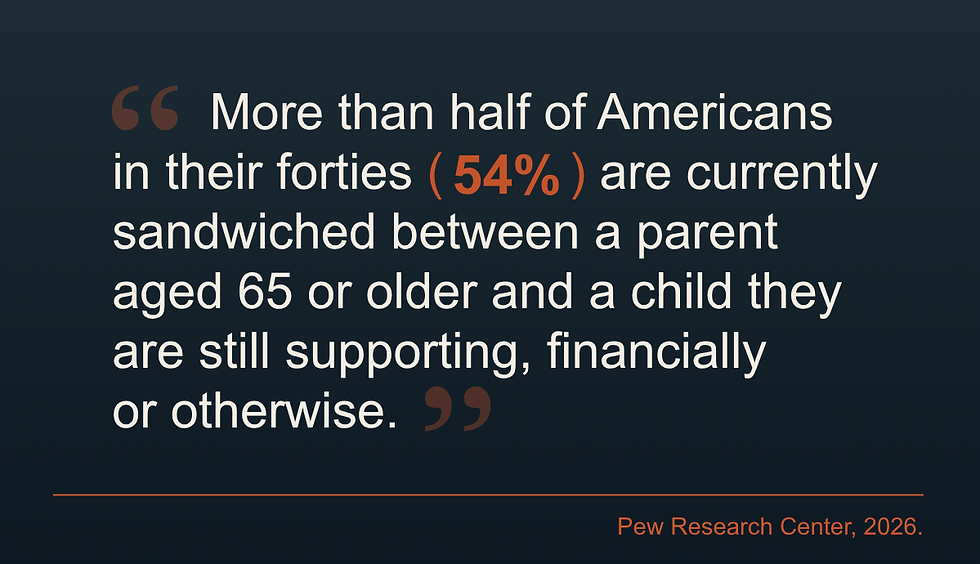
More than half of Americans in their forties (54 percent) are currently sandwiched between a parent aged 65 or older and a child they are still supporting, financially or otherwise.
That is not a rare intersection. It is close to the median experience of that entire decade of life, which means the conversation about aging parents rarely arrives in isolation. It shows up while you are also funding your own retirement accounts and possibly a child’s education.
Behavioral finance offers a useful explanation for why families still put this off. When a topic feels emotionally uncomfortable, or when the information involved might require action we’d rather avoid, we tend to look for reasons to delay.
Researchers call this avoidance the ostrich effect, and conversations about a parent’s finances and health sit squarely inside it.
The irony is that avoidance rarely prevents the eventual conversation. It just moves it to a moment with far fewer good options.
Framing changes everything here. Raising the subject as a question about a parent’s competence tends to land as an accusation, even when none is intended. Reframing it around your own preparations, mentioning that your financial professional recently walked you through updating your own estate documents, can open the door instead of triggering defensiveness.
Could it also help financially? Caregivers report out-of-pocket costs averaging around $7,200 a year, which can be an unexpected drain on a family’s finances.
What Should You Do When You Receive an Inheritance?
Most people assume inheritance is primarily a financial question. In practice, it is often an emotional event with financial decisions attached, and treating it as purely financial is where the trouble begins.
Research firm Cerulli Associates has put numbers on the scale of what’s coming:
$124 trillion is expected to change hands in the United States through 2048
$105 trillion of that goes directly to heirs, with the remainder to charity
Baby boomers and older generations account for 81 percent of the transfer
More than half of the total dollar volume comes from households that are currently high net worth or ultra-high net worth, a group that makes up only 2 percent of all households
What tends to surprise people is how often that money doesn’t last or isn’t used the way anyone intended. A landmark baby boomer study by Ohio State University found:
Recipients save, on average, only about half of what they inherit
More than a third (34.9 percent) ended up with no more wealth than before, or less
Even among people who inherited $100,000 or more, nearly one in five (18.7 percent) spent or lost all of it within two years
The pattern isn’t about financial literacy. It’s about receiving a large sum during one of life’s more emotionally charged moments and making decisions before the emotional weight has had time to settle.
The better approach is almost boringly simple:
Pause before acting
Understand exactly what you’ve inherited, since a brokerage account and a piece of real estate are very different
Ask your tax, legal, or accounting professional if there will be any tax implications. Update your financial professional as well.
Update your own financial strategy, if appropriate
Only then make intentional decisions about what to do with the money
“An inheritance often arrives during one of life’s most emotional seasons.”

How Do You Prepare for a Business Sale or Stock Windfall?
This one isn’t only about founders selling a business. It applies just as much to an executive who has spent ten years at a company or an early employee who was offered an equity stake in the business. In each case, wealth that took a decade or more to build can become liquid within weeks.
The Exit Planning Institute’s 2023 survey of privately held U.S. businesses found:
Roughly 80 percent of a typical owner’s net worth is tied up in the business itself
73 percent of privately held U.S. companies are preparing to transition ownership within the next decade, a wave of transactions worth an estimated $14 trillion
Nearly half (48 percent) expect to exit within five years
Yet 78 percent of owners still have no formal transition team in place
The wealth may be scheduled to move, but the infrastructure needed to move it well often is not.
The personal finance decisions that can matter most are often far easier to make before a liquidity event than after one.
Consider managing concentration risk gradually, if permitted
Structuring the transaction to help manage taxes, if permitted
Consider gifting shares to family before a valuation event, if permitted
Deciding in advance how a windfall will or won’t change your lifestyle, if permitted
Once the money lands, some options may no longer be available, and what remains is working with the decisions that have already been made. The mindset shift that matters most is moving from accumulation to stewardship, deciding what the money is now for.

“Information can tell you what’s possible. Preparation helps determine what’s right for your family.”
Is a Will Enough to Protect Your Legacy?
Estate management is frequently discussed as a paperwork problem: get a will in place and the beneficiaries named, then move on. The documents matter, but they may play a more limited role in whether a legacy holds together after you’re gone.
The paperwork gap is real and getting worse:
Only 24 percent of Americans currently have a will, down from 33 percent in 2022
43 percent of people without one say they simply haven’t gotten around to it
But even families who do have documents in place often haven’t done the harder work behind them.
A trust can help, but remember using a trust involves a complex set of tax rules and regulations. Before moving forward with a trust, consider working with a professional who is familiar with the relevant rules and regulations.
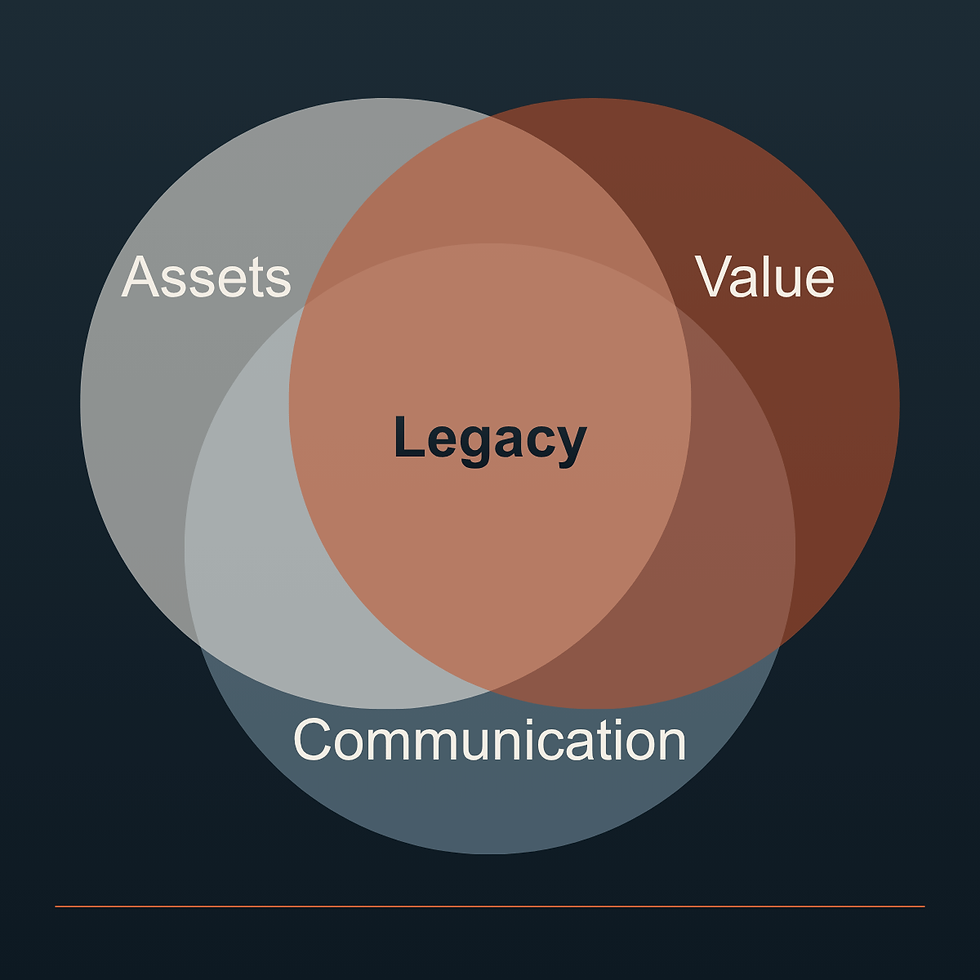
Estate management is the process of treating a legacy as an ongoing practice rather than a one-time signing. Some families:
Review beneficiary designations after every major life event. An outdated form naming an ex-spouse or deceased relative can send those assets somewhere entirely different from what the will intended.
Talk with adult children, not necessarily about exact dollar amounts, but about the values and reasoning behind major decisions
Organize the practical details, account locations, personal finance contacts, and digital access so that a difficult season isn’t made harder by a scavenger hunt for basic information
Preparation, Not Prediction
Running through all five of these moments is the same uncomfortable truth: the decision itself rarely announces when it’s coming. Retirement can get moved. A parent’s decline accelerates faster than expected. An inheritance arrives during a year already full of change. An acquisition offer shows up before the business is prepared. None of that is a reason to guess at timing. It’s a reason to build flexibility long before you need it.
AI can now answer questions about these topics instantly, and that’s a real help for getting oriented. What it can’t do is sit across the table and understand what your family actually values, and help you sort through the many technical decisions that affect your specific situation. That is where an ongoing relationship with a financial professional can make the greatest difference, not by reacting to the moment, but by making sure the years leading up to it were used to prepare for it.
The biggest financial decisions rarely become important on the day they happen. They become important years earlier. We’re glad to help our clients use those years wisely, whichever of these five moments they’re currently preparing for.
Frequently Asked Questions
What Is the Best Age to Start Retirement Conversations with a Financial Professional?
Most of the decisions that shape retirement outcomes, such as Social Security timing and income sequencing, are considered years before retirement. Starting earlier can give you more options.
What Is Sequence of Returns Risk, and Why Does It Matter So Much?
It refers to the outsized impact that investment returns in the first several years of retirement can have on a portfolio. In fact, a portfolio’s performance in the first year of retirement can explain nearly 14 percent of the variation in how a 30-year retirement strategy ultimately performs, more than any other individual year. That’s why the years immediately before and after retirement deserve particular attention.
When Should Families Start Talking to Aging Parents About Finances?
Ideally, the conversation starts while parents are healthy and fully capable of participating in the decision, not after a health event has already limited their options.
What Should Someone Do First After Receiving an Inheritance?
Consider pausing before making major decisions. Also, understand what type of assets you’ve actually received, since brokerage accounts, retirement accounts, and real estate can be very different. Your tax, legal, and accounting professional can provide insights. Your financial professional can also help.
How Much Wealth Is Expected to Transfer Between Generations in the Coming Decades?
Cerulli Associates projects $124 trillion will transfer in the United States through 2048, with $105 trillion going to heirs and the rest to charitable causes.
What Is Concentration Risk, and Why Does It Matter for Business Owners and Executives?
It’s the risk of having an outsized share of your net worth tied to a single asset, whether that’s a private business or company stock. For the average business owner, about 80 percent of their net worth is connected to the business.
How Far in Advance Should a Business Owner Start Preparing for a Sale?
Years, not months. The tools that can help manage a transaction may need to be in place well before any sale is finalized. Some may lose their effectiveness once a deal is imminent or signed.
What Estate Documents Matter Most?
That depends on your situation. A will, updated beneficiary designations, and powers of attorney are often foundational. A trust may also be approrpiate depending on your circumstances and goals. But documents alone don’t guarantee a smooth transition. Family communication about values and intentions can matter just as much as the paperwork itself.
Can AI Replace the Guidance of a Financial Professional for These Kinds of Decisions?
AI is a strong tool for gathering general information quickly, but it doesn’t know your family’s specific history, values, or goals, and it can’t weigh trade-offs the way a financial professional who knows your full financial picture can. It’s best used as a starting point for questions, not as the final word on decisions.
* To qualify for the tax-free and penalty-free withdrawal of earnings, Roth IRA distributions must meet a 5-year holding requirement and occur after age 59½. Tax-free and penalty-free withdrawals can also be taken under certain other circumstances, such as the owner's death. The original Roth IRA owner is not required to take minimum annual withdrawals.
Sources:
EBRI, 2026 at https://www.ebri.org/docs/default-source/rcs/2026-rcs/2026-rcs-release-report.pdf?sfvrsn=1229022f_4
Investment Company Institute Research Perspective, 2026 at.https://www.ici.org/system/files/2026-06/per32-07.pdf
RetirementResearcher.com, 2026 at https://retirementresearcher.com/everyone-experience-different-retirement-income-outcomes/
Pew Research Center, 2026 at https://www.pewresearch.org/short-reads/2022/04/08/more-than-half-of-americans-in-their-40s-are-sandwiched-between-an-aging-parent-and-their-own-children/
TheDecisionLab.com, 2026 at https://thedecisionlab.com/biases/ostrich-effect; https://www.psychologytoday.com/us/blog/loaded/201904/the-ostrich-effect
AARP, 2026 at https://www.aarp.org/caregiving/financial-legal/financial-impact-caregiving/
Cerulli Associates, 2026 at https://www.cerulli.com/press-releases/cerulli-anticipates-124-trillion-in-wealth-will-transfer-through-2048
News.OSU.EDU, 2026 at https://news.osu.edu/most-americans-save-only-about-half-of-their-inheritances-study-finds---ohio-state-research-and-innovation-communications/
Exit-Planning-Institute.org, 2026 at https://exit-planning-institute.org/2023-national-state-of-owner-readiness
Caring.com, 2026 at https://www.caring.com/resources/wills-survey
NewsRoom.BankOfAmerica.com, 2026 at https://newsroom.bankofamerica.com/content/newsroom/press-releases/2023/11/spontaneous-family-wealth-discussions-and-decisions-can-lead-to-.html
The information contained on this site is intended for general informational purposes only, may not reflect current developments; does not constitute investment, tax, or legal advice; and should not be relied upon for such purposes. Estate planning rules vary significantly by state and individual circumstances. There is no guarantee that any forecasts made will come to pass. We make no representation about the accuracy of the information or its appropriateness for any given situation. This information is not an offering. Past performance does not guarantee future results.