

Helping Your Adult Children Buy a Home: Smart Ways to Gift a Down Payment

Buying a first home has become far more difficult for younger generations than it was for many of their parents. Rising home prices, higher interest rates, and the challenge of saving for a down payment have pushed the dream of homeownership further out of reach for many otherwise responsible and hardworking young adults. As a result, more families are exploring ways to help the next generation take that important step. If you are considering helping a child or grandchild with a down payment, it may be worth thinking carefully about how to do it in a way that supports them while still fitting within your broader financial and estate planning strategy.

Key Takeaways Here are some questions this blog aims to answer:
|
Why Home Buying May Feel Harder for Your Children or Grandchildren Than It Was for You
If you feel like your kids are working hard and still finding it increasingly difficult to buy a home, you are not alone.
We have many clients whose adult children are looking to trade in a rental for a mortgage payment. If your loved ones are in this situation, you may be interested in some of the information we’ve discovered and the strategies we’ve developed.
According to a recently released report from the National Association of Realtors, the typical first-time homebuyer in the U.S. is now 40 years old, a record high age. This represents an increase from 38 years old in 2024, and it has risen sharply from 33 five years ago.
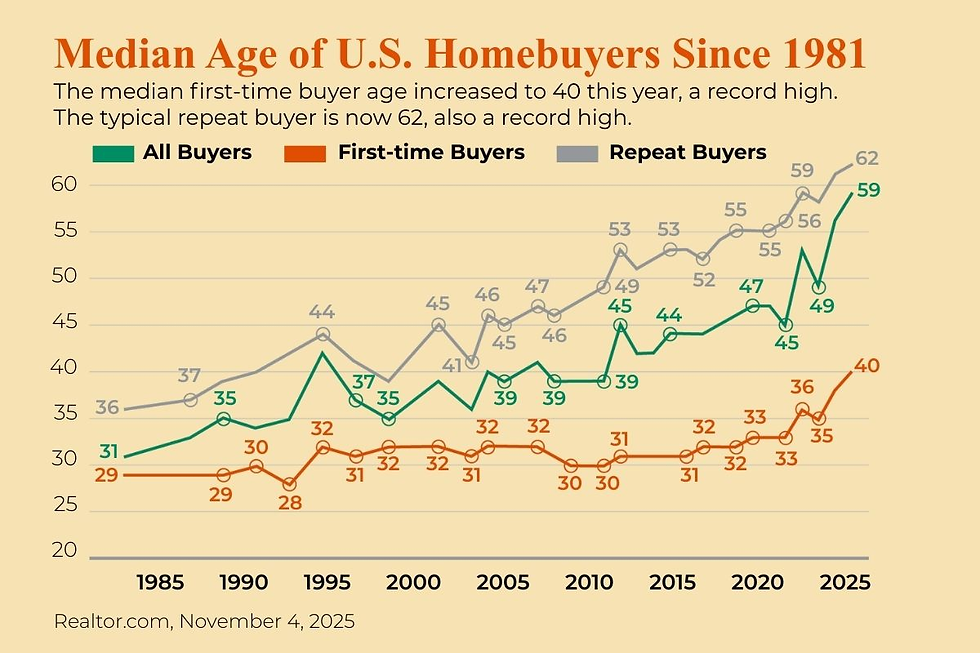
What’s more, the share of all home purchases made by first-time buyers fell to 21 percent in 2025, the lowest since records began being kept in 1981.
Delayed home buying may temper wealth creation. Homebuyers who delay their first home purchase until they are 40 lose about $150,000 in equity on their starter home compared with those who purchase 10 years earlier at age 30.
Housing affordability is a major part of the story behind delayed homeownership. In the mid-1980s, a typical home cost roughly three and a half times the median household income. Today, it is closer to five times income, and in some markets, it is much higher.
The salary needed to buy a home has doubled from 2017 to 2025, and wage growth just hasn’t kept up. This has resulted in a widening of the home affordability gap.
As the chart below illustrates, in 2025, the median American home costs $416,900, versus the median annual household income of $83,150.

The gap between American home prices and incomes is even more pronounced in coastal U.S. cities. For example, the median home price in LA is 12.5 times the median annual household income, and 9.8 times in New York City.
Because younger generations typically don’t have equity built up in an existing home they can sell, first-time buyers have to rely solely on their savings and investments to come up with a down payment for their first home purchase. This can result in a smaller down payment. Couple that with elevated mortgage rates (at least based on recent history), and many first-time buyers are finding that they cannot afford the mortgage payment, so they continue to rent.
Affordability becomes more of an issue when you layer on student loans, childcare costs, and a baseline standard of living that now assumes two cars, smartphones, internet, and a long list of “non-negotiables” that previous generations never considered. It’s not surprising that in this current environment, many otherwise successful young adults are stuck renting for much longer than previous generations.
All this is making it increasingly difficult for individuals to join the ranks of homeownership, a long-time tenet of the “American Dream.” From 2024 to 2025, the percentage of first-time buyers has decreased from 24 to 21 percent.
That’s where parents and grandparents may be able to step in and help.

Parents and Grandparents Are Filling the Gap
Not only are first-time buyers older, but more of them are also relying on family help to get into a home. The National Association of Realtors in its 2025 report showed that nearly a quarter of first-time buyers used gifts or loans from friends and family for their down payment. This assistance has helped the median down payments for first-time home buyers to hit 10 percent, the highest since 1989.
Another survey found that nearly 80 percent of Gen Z homeowners, those between the ages of 18 and 26, received some financial support, mostly from parents, for their down payments.
If you are in a position to help a child or grandchild with a down payment, you are part of a growing trend. The key is doing it in a way that:
Supports your child without jeopardizing your own financial goals
Fits within a thoughtful personal finance strategy
Is designed to provide some protections if your child divorces or the relationship changes
We won’t comment on when, where, or how your child should or shouldn’t buy a home. However, we are sharing the following framework for your consideration when evaluating your options before offering a down payment.
Clarify Your Goals and Boundaries
Before you make the decision to help with, or outright pay, the cost of a down payment, you may want to answer a few basic questions:
Do you want this to be a gift, a loan, or something in between?
How much can you truly afford to give or lend without impacting your own long-term financial strategy?
How important are “strings” or stipulations, such as protections around divorce, repayment, or what happens if the home is sold?
What do you think about fairness among children or grandchildren?
Having a point of view on these considerations first may make the more technical decisions easier.
What Are Five Strategies You May Want to Consider to Help With Homeownership?
We’ve pulled together five strategies you may want to consider for helping your children or grandchildren with what may be one of the most consequential purchases to date.
An outright cash gift for the down payment
An intra-family loan, possibly through a trust
Co-owning the property or taking an equity share
Having a trust or LLC own the home
Gifting an existing property
Please remember, this article is for informational purposes only and is not a replacement for real-life advice. Consult your tax, legal, or accounting professional to see how these strategies may fit with your overall tax situation. Also, using a trust, as discussed below, involves a complex set of tax rules and regulations. Before moving forward with any type of trust, consider working with a professional who is familiar with the relevant laws and regulations.

Strategy 1: An Outright Cash Gift for the Down Payment
For many families, the most straightforward path to helping with a down payment is a direct cash gift.
How the Gifting Tax Rules Work
For 2026, you can give up to $19,000 per recipient without using any of your lifetime estate and gift tax exemptions. A married couple can effectively double that amount per recipient, and you can also give separately to your child’s spouse. That means two parents could move $76,000 to a married child and their spouse in a single year without tapping the lifetime exemption.
Amounts above the annual exclusion simply use part of your lifetime estate and gift tax exemption, which is $15 million per person in 2026 under the recently passed One Big Beautiful Bill Act (OBBBA).
Pros
A gift can be simple to execute.
Clean from a mortgage underwriting standpoint, since lenders tend to be accustomed to “gift letter” documentation.
Besides helping children or grandchildren, gifting can help reduce the size of your taxable estate.
Considerations
Once you gift the money, it’s no longer your asset.
If your child or grandchild is married and the down payment is treated as part of the marital home, some portion of that value may be subject to division in the event of a divorce, depending on state law.
If divorce protection is a priority, an estate attorney in your state may have you consider:
Gifting to your child alone, not to the couple, and documenting that it is intended as your child’s separate property.
Keeping the gift segregated before closing, with a clear paper trail that ties your gift to your child’s share of the equity.
Encouraging a marital agreement that acknowledges family gifts as separate property.
Consider documenting any cash gifts and incorporating this information into your overall estate strategy to avoid confusion later.

Strategy 2: An Intra-Family Loan, Possibly Through a Trust
Instead of an outright gift, some families prefer to structure down payment assistance as a loan.
At a basic level, this means lending money to your child at a reasonable interest rate and documenting it with a promissory note and a payment schedule.
Pros
With a loan, you can keep some leverage, since you can require repayment if circumstances change.
Having “skin in the game” through a loan may create a stronger sense of responsibility for the child.
A personal loan can always be forgiven gradually over time using annual gift tax exclusion if you choose.
Considerations
To make this legally binding, the loan requires formal documentation, clear terms, and a clear understanding of the consequences of missed payments.
Certain mortgage lenders will not allow a second loan, so this is often used for part of the purchase price in cash rather than a true second mortgage.
Some high-net-worth families formalize a down payment loan into a family loan trust or “family bank,” where a trust makes loans to children and grandchildren according to set policies. This can align with broader estate strategy goals, but this approach can add complexity and requires coordination with your attorney and CPA.
Strategy 3: Co-owning the Property or Taking an Equity Share
Another approach some parents and grandparents use is to co-own the home with the child or take a documented equity share rather than gifting or lending the full amount. For example, you provide part of the down payment in exchange for twenty or thirty percent of the property.
Pros
This approach may clarify ownership and future appreciation sharing.
This may provide some protection in case of divorce, because your share is not part of the marital estate.
You can choose later whether to gift or sell your interest, depending on your estate strategy and your child’s situation.
Considerations
You are now in business together. You need clarity on who pays for repairs, what happens if someone wants to sell, and how to resolve disputes.
There may be implications for capital gains when the property is eventually sold, particularly for your share if the home is not your primary residence.
This structure of assistance may work well if you already view the property as part investment and part assistance, for example, buying a duplex where your child lives in one unit while renting the other.
Strategy 4: Having a Trust or Other Legal Entity Own the Home
In some cases, families may want to separate ownership from use of the home. An attorney can set up a trust or a limited liability company (LLC) that would own the house, and the child would either pay rent or have the right to live there. Over time, you may gift interests in the trust or LLC, or you may hold ownership until death and pass it through your estate.
Pros
Using a legal structure gives you strong control over the gifted asset.
The trust or LLC may be designed to potentially protect against divorce or creditors.
This type of legal entity may be easier to coordinate with a broader multi-generational estate strategy.
Considerations
Without direct ownership, your child or grandchild is not building equity in their own name since the trust or entity owns the home.
Trusts and LLCs require careful legal and tax considerations, and may affect property taxes and mortgage options.
This strategy tends to be most appropriate when the purchase is large relative to the rest of the estate or the family is already using trusts and entities for other purposes.
Strategy 5: Gifting an Existing Property
Finally, you may already own a home, condo, or rental property that you want to serve as your child’s first home. If this is the case, you may want to gift full ownership outright, gift partial interest over time, or sell the property to your child and consider the discount a gift.
Pros
Gifting property allows you to pass down assets to your child immediately, allowing you to see the benefits of providing a financial foundation for future generations.
By gifting property while you are alive, you can incorporate the decision in your estate-management strategy.
Gifting property allows you to retain some control over how the asset is used, as you can set conditions for its use or require that the property remain within the family.
Considerations
Gifting property can have capital gains tax consequences for your child.
If your child eventually sells the property, they could face capital gains taxes. Gifted real estate does not receive a step-up in basis. When you give away your property, the original cost of the property for the giver becomes the tax basis for the recipient.
Estate Considerations You Should Not Ignore
Regardless of the structure you choose to assist your child in affording that first home, make sure your help with a down payment fits into your overall estate strategy. Key points to keep in mind:
Track gifts carefully so that your estate documents and personal records accurately reflect who has received what and when.
Work with your tax, legal or accounting professional with an eye toward any state estate or inheritance taxes, which can apply at much lower thresholds than federal rules, depending on the state.
Revisit your beneficiary designations and wills or trusts, especially if you intend to “equalize” among children who may not need or receive the same level of housing assistance.
Think ahead about the higher lifetime estate and gift tax exemption created by the OBBBA, which may influence the timing and structure of your larger gifts.
Bringing the Generations Together
Today, your children and grandchildren are navigating a world where two incomes are often required to cover the basics. For a variety of reasons, even the traditional starter home may be out of reach for them. It’s become easy to see why many in the younger generations feel like they are running in place.
Framing your help with a down payment as a partnership across generations rather than a one-time rescue can be powerful. You are not just writing a check. You are:
Sharing your own story about how you bought your first home
Teaching your children how to think about big financial decisions
Designing a thoughtful transfer of wealth that aligns with your values
Helping Your Child or Grandchild Buy a House Is an Important Decision
As financial professionals, we’re here to help you evaluate your options and build a strategy around your financial goals, including if one of those goals is helping your child or grandchild put a down payment on a house.
If you’d like to explore what makes the most sense for your situation, we invite you to start that conversation with us. We can also put you in touch with other professionals who may have other insights.
The information contained on this site may not reflect current developments; does not constitute investment, tax, or legal advice; and should not be relied upon for such purposes. There is no guarantee that any forecasts made will come to pass. We make no representation about the accuracy of the information or its appropriateness for any given situation. This information is not an offering. Past performance does not guarantee future results.


